Mammalian cell culture
Low-shear, high-control bioreactors for mammalian cells — glass at the bench for visibility and development, stainless steel for GMP production — from monoclonal antibodies to viral vectors.
The challenge
Mammalian cells are the backbone of modern biopharma: monoclonal antibodies, recombinant proteins, cell therapies and viral vectors. They are also fragile — sensitive to shear stress and to swings in dissolved gases and pH. In a stirred tank, the main shear-damage sources are the high-energy impeller zone, gas-bubble burst, and high gas-inlet velocity at the sparger [1]. Even though CHO lines are relatively robust, elevated energy-dissipation rates measurably cut productivity: one study reports ~25% lower specific mAb productivity at ε = 0.4 W/kg versus 0.01 W/kg [1].
So the process must transfer enough oxygen and mix homogeneously while keeping hydromechanical stress low — and it must do so reproducibly as the culture scales from a bench vessel to a production tank.
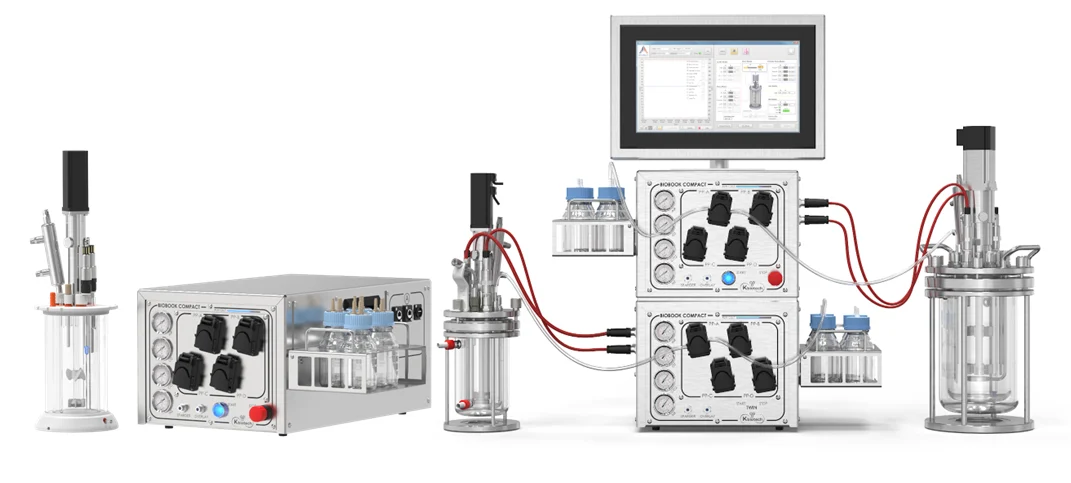
From R&D to full-scale manufacturing: VINCI Technology empowers your scale-up with glass, single-use, and stainless steel stirred systems
Low-turbulence stirred-tank vessels with impellers sized to minimise shear, gentle aeration and advanced gas control — in glass for R&D and stainless steel for production.
- Glass for R&D, steel for production. Transparent glass benchtop vessels give direct process visibility for development and small-scale work; 316L stainless steel provides the SIP sterilisation, pressure rating and durability required for GMP manufacturing.
- Low-shear agitation. Pitched-blade and marine impellers for homogeneous mixing without damaging cells.
- Microsparger & surface aeration. Modulated oxygen transfer with controlled foaming.
- Perfusion mode + Bioflex™. High-cell-density culture with cell retention and continuous media exchange, under automated, FDA 21 CFR Part 11-compliant recipe control.
From research to production, one platform
The same parameters and Bioflex™ recipes carry you from bench to industrial scale, reducing transfer risk between stages.
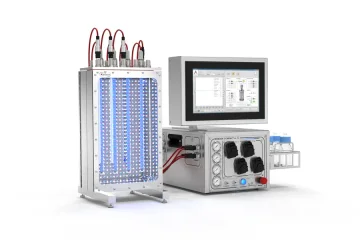
R&D In-Situ Sterilizable Bioreactors & Fermenters
BioSIP series.
See system →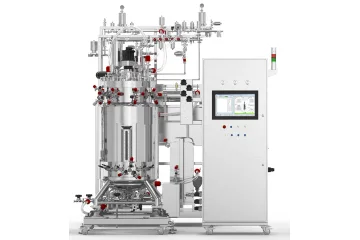
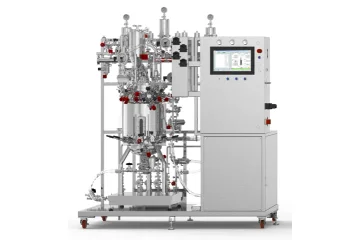
Pilot & Production In-Situ Sterilizable Bioreactors & Fermenters
BioFerm series.
See system →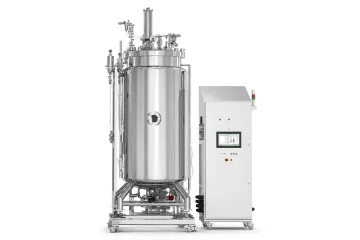
Large-Scale In-Situ Sterilizable Bioreactors & Fermenters
Custom bioreactors.
See system →Performance benchmarks
Figures below are literature/industry benchmarks — not VINCI or client-owned results.
- Shear directly affects yield. Specific mAb productivity dropped ~25% under high energy dissipation (0.4 vs 0.01 W/kg), quantifying why low-shear design matters [1].
- Predictable scale-up. Using volumetric power input as the scale-up criterion reproduces cultivation conditions across three orders of magnitude, from microplate to stirred tank [2][3].
- Perfusion for high density. Perfusion enables high-cell-density culture with continuous media exchange; stirred tanks show strong specific-antibody production in mid-to-late phases [2].
Scientific sources
- Analysis of cell lysis / shear damage — shake tube vs stirred-tank perfusion CHO cultures (PMC)
- Scale-up of CHO cell cultures: from 96-well plates to stirred tank reactors across three orders of magnitude — Journal of Biological Engineering (PMC)
- Scale-up of a monoclonal antibody CHO fed-batch in stirred-tank bioreactors: hydrodynamic conditions and feeding regimen (PMC)
Let’s talk about your process
Tell us about your application: our engineering team replies within 24 hours.

Frequently asked questions
Two systems, along the same path. Development uses benchtop glass, which gives direct sight of the culture; GMP production moves to stainless steel. In both, the configuration for CHO and HEK293 is built around low shear: pitched-blade and marine impellers, microsparger and surface aeration, and perfusion mode where high cell density is required.
Mammalian cells have no rigid cell wall, so shear has to be limited on two fronts: agitation and bubbles. On agitation, pitched-blade and marine impellers mix homogeneously at moderate speed. On aeration, microsparger and surface aeration are combined, with foam under control, to modulate oxygen transfer without exposing the cells to bubble burst.