Biogas & biofuel
One platform for biogas and biofuel: the safety of Vinci stainless steel, from 1 L up, to overcome the limits of glass in CH₄ and H₂ production.
The challenge
Biogas turns organic waste — food waste, agro-industrial residues, manure — into renewable methane via a microbial consortium working without oxygen. The difficulty is stability: the process depends on a delicate balance between acid-forming and methane-forming microbes. Push the organic loading rate (OLR) too high and volatile fatty acids accumulate, the pH drops and digestion stalls; one study saw inhibition set in at 12–16 g VS/L/day from VFA build-up [1]. And because the methane-rich product gas forms a flammable, potentially explosive atmosphere, the whole plant must be engineered for safety under ATEX — a requirement that shapes vessel, instrumentation, gas-line and electrical design from the start.
Biofuel research sits at the opposite, experimental end of the same bioenergy space: screening strains, feedstocks and conditions to maximise the energy-carrying product — lipids for biodiesel, or ethanol/hydrogen from fermentation. Yields swing strongly with light, nutrients, CO₂ and redox, so researchers need to run many controlled iterations and see what the culture is doing. Both routes share the same logic: observable glass vessels for R&D and study, robust stainless steel for production.
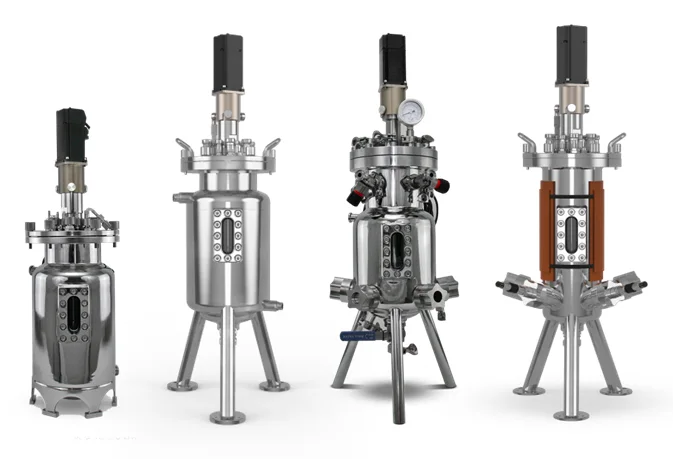
VINCI technology: at the forefront of bioenergy, from 316L stainless steel benchtop bioreactors for R&D up to ATEX industrial scale
Maximise your biogas and biofuel yield with our continuously stirred anaerobic digesters. With flexible 316L stainless steel bioreactors, precision controls for ultra-stable methanogenesis and inherently safe gas handling, VINCI removes the risks and speeds up the move from lab to production.
- Glass for R&D, steel for production. Transparent glass vessels for biomethane-potential (BMP), biofuel screening and process development with full visibility; stainless steel for durable production with SIP/CIP.
- Stable loading & mixing control. OLR, mixing, temperature and pH control to prevent VFA accumulation and keep methanogenesis stable [1][2].
- Dedicated gas management. Handling of the methane-rich product gas, engineered for the flammable atmosphere it creates.
- Custom ATEX plant design. Because biogas produces a flammable, potentially explosive atmosphere, ATEX-compliant design is central. VINCI's engineering consultants design customised ATEX systems tailored to each client's process, site and zone classification — rather than a one-size-fits-all configuration.
- Flexible biofuel configuration. The glass vessel reconfigures readily for photoautotrophic (microalgal lipid) or heterotrophic/fermentative (ethanol, hydrogen) biofuel routes.
- Bioflex™ control. Automated recipes and continuous data logging for repeatable, auditable operation.
From research to production, one platform
The same parameters and Bioflex™ recipes carry you from bench to industrial scale, reducing transfer risk between stages.
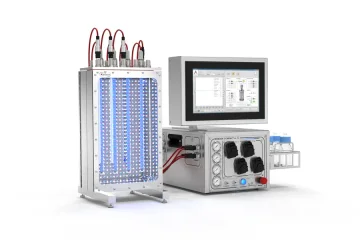
R&D In-Situ Sterilizable Bioreactors & Fermenters
BioSIP series.
See system →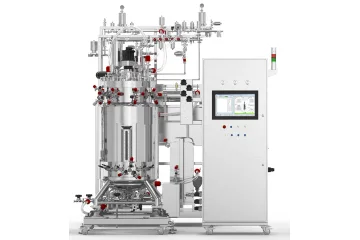
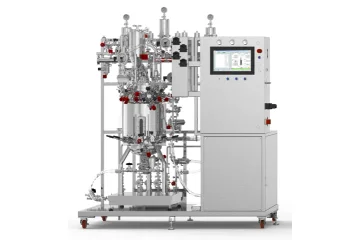
Pilot & Production In-Situ Sterilizable Bioreactors & Fermenters
BioFerm series.
See system →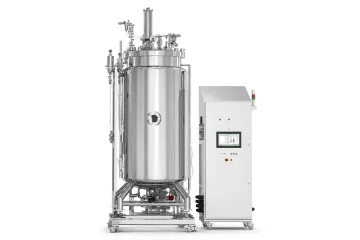
Large-Scale In-Situ Sterilizable Bioreactors & Fermenters
Custom bioreactors.
See system →Performance benchmarks
Figures below are literature benchmarks for anaerobic digestion and microalgal biofuel — not VINCI or client-owned results.
- High methane yields from food waste. CSTR digestion of food waste reports methane yields around 0.42 m³/kg VS (at OLR 1 kg VS/m³·d), and up to ~423 mL CH₄/g VS in optimised operation [1][3].
- Strong COD reduction. Optimised food-waste CSTRs achieved ~80% COD reduction alongside high methane yield [1].
- Loading rate is the key lever. Yields fall and digestion can stall as OLR rises (e.g. inhibition at 12–16 g VS/L/day), underlining why loading control matters [1].
- Biofuel: lipid content is highly tunable. Oleaginous microalgae (e.g. Nannochloropsis) accumulate neutral lipids for biodiesel, with productivity strongly dependent on nutrients, light and salinity — variables best explored in observable lab vessels [4][5].
- Multiple fuel routes from one platform. Microalgal biomass feeds several biofuels — biodiesel (lipids), bioethanol/higher alcohols, and biohydrogen via dark fermentation — all amenable to controlled bench study [6].
Scientific sources
- IoT-based anaerobic digestion of food waste — methane yields, OLR inhibition, COD reduction (ScienceDirect)
- Sustainable biogas production via anaerobic digestion with focus on CSTR technology: a review (ScienceDirect)
- Biogas by semi-continuous anaerobic digestion of food waste — Applied Biochemistry and Biotechnology (Springer)
- Growth kinetics and biodiesel lipid extraction of Nannochloropsis oculata in a photobioreactor under varying salinity (ResearchGate)
- Microalgae as sustainable renewable energy feedstock for biofuel production (PMC)
- Utilization of microalgal biofractions for bioethanol, higher alcohols, and biodiesel production: a review — Energies
Let’s talk about your process
Tell us about your application: our engineering team replies within 24 hours.