Bacterial fermentation
High-oxygen-transfer bioreactors for high-cell-density microbial fermentation — glass for development, stainless steel for robust production — engineered for the intense aeration and thermal load these cultures demand.
The challenge
Recombinant proteins, industrial enzymes and plasmid DNA nearly all begin as a bacterial fermentation. The design constraint never changes: a strain that doubles in twenty minutes consumes oxygen faster than an undersized vessel can deliver it. Past roughly 70 g/L of cell mass, recombinant E. coli is no longer limited by substrate — it is limited by how much oxygen crosses the gas–liquid interface [1]. Two quantities follow from that, and they are the ones we size the reactor around: the volumetric transfer coefficient (kLa), and the thermal load the jacket has to shed at peak growth — without losing sterility between consecutive batches.
Which is why the line splits in two. In development what matters is seeing what happens inside the vessel — foaming, turbidity, wall growth — and glass allows it. In production what matters is working pressure, sterilisation in place and a service life measured in years: from there on it is steel.
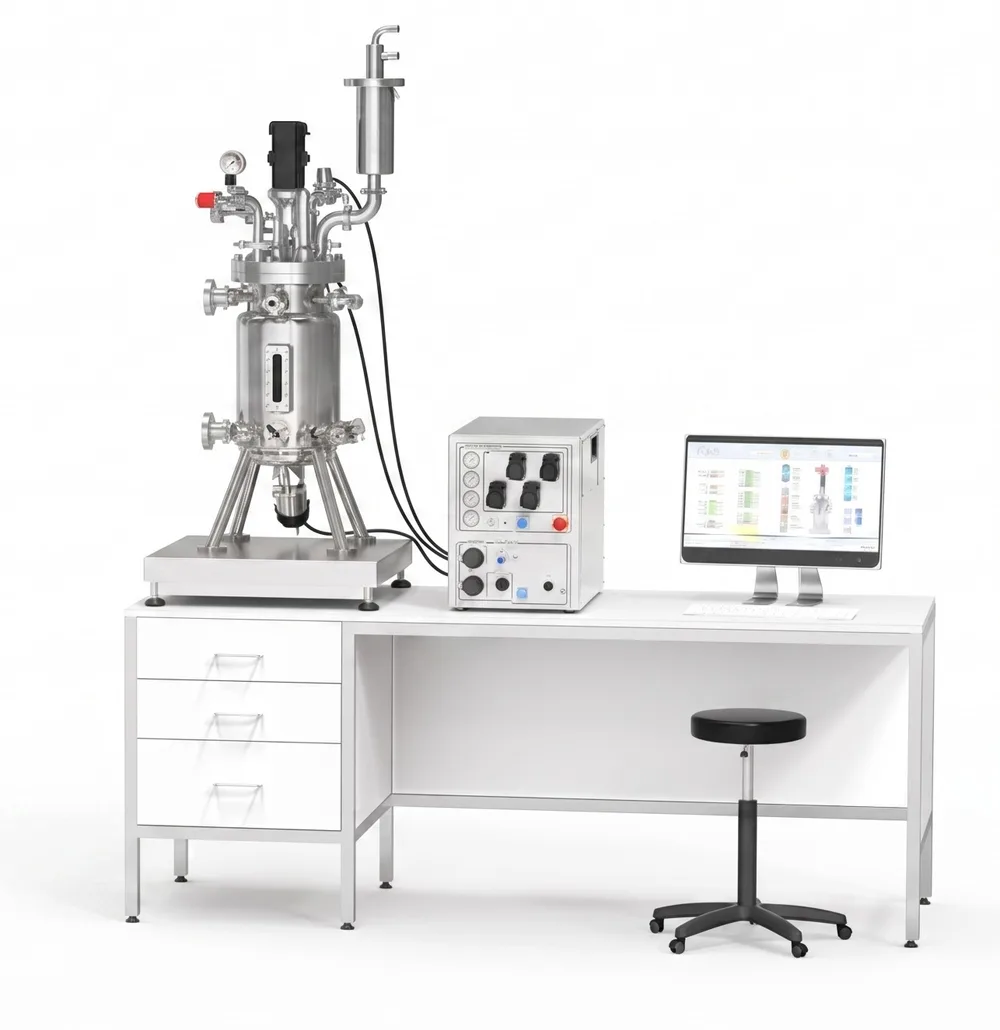
The VINCI technology applied — high-power stirred tank (glass → steel)
High-specific-power stirred vessels, Rushton impellers and ring spargers: the combination that sustains the oxygen transfer dense microbial cultures demand, managed by Bioflex™.
- Oxygen transfer. The Rushton turbine remains the obligatory choice when high kLa is needed: it is radial, it shears bubbles apart and holds them in the mixing zone instead of driving them to the surface. In a multiple configuration with a ring sparger, application literature reports maxima around 308 h⁻¹, corresponding to an OTR of roughly 350 mmol/L·h [2].
- Glass in development, steel in production. Glass vessels for method development and direct observation; 316L stainless steel with SIP/CIP wherever repeatability, sterility and long service life matter.
- Shedding the heat. Jackets and coils sized on the metabolic peak, not the batch average: it is the peak that decides whether temperature stays in band.
- DO cascade and Bioflex™ recipes. Dissolved oxygen drives agitation, gas flow and O₂ enrichment in cascade — DO-stat feeding included — with recorded, repeatable recipes.
From research to production, one platform
The same parameters and Bioflex™ recipes carry you from bench to industrial scale, reducing transfer risk between stages.
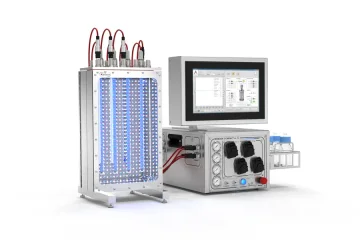
R&D In-Situ Sterilizable Bioreactors & Fermenters
BioSIP series.
See system →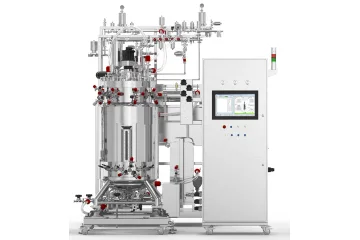
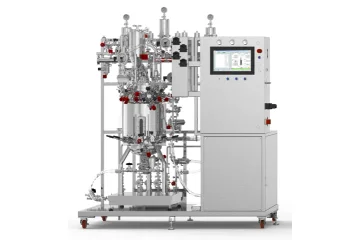
Pilot & Production In-Situ Sterilizable Bioreactors & Fermenters
BioFerm series.
See system →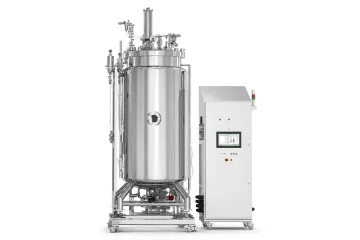
Large-Scale In-Situ Sterilizable Bioreactors & Fermenters
Custom bioreactors.
See system →Performance benchmarks
The figures below are benchmarks from published literature and industry application notes — not results obtained by VINCI or its clients.
- kLa up to ~308 h⁻¹. Measured in a stirred vessel with two 6-blade Rushton impellers and a ring sparger — the order of magnitude dense microbial fermentation requires [2].
- High cell density. Documented fed-batch E. coli processes reach OD₆₀₀ ≈ 201, around 76 g/L dry cell weight [2].
- DO-stat feeding. Driving feed rate from dissolved-oxygen swings is an established route to high density and high recombinant-protein titres [1][2].
Scientific sources
- High cell density cultivation of E. coli for recombinant protein production (PMC)
- Industry application note — high-cell-density E. coli culture in a stirred-tank vessel with Rushton impellers and a ring sparger (kLa ≈ 308 h⁻¹, OD₆₀₀ ≈ 201, dry cell weight ≈ 76 g/L)
Let’s talk about your process
Tell us about your application: our engineering team replies within 24 hours.