Bioprocess scale-up from bench to production
Transferring a process from one scale to another is not multiplying a volume: it changes how the culture receives oxygen, how it is mixed and the shear it undergoes. This page sets out the criteria a transfer is held against and the four-stage path, from 250 mL to over 1,000 L WV, along which the Vinci platform carries it.
From research to production, one platform
The same parameters and Bioflex™ recipes carry you from bench to industrial scale, reducing transfer risk between stages.
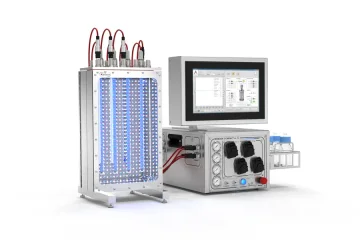
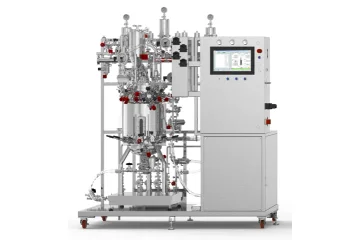
R&D In-Situ Sterilizable Bioreactors & Fermenters
BioSIP series.
See system →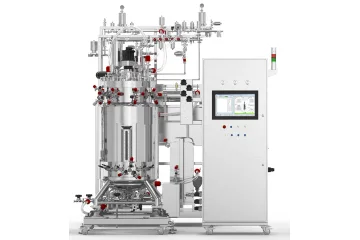
Pilot & Production In-Situ Sterilizable Bioreactors & Fermenters
BioFerm series.
See system →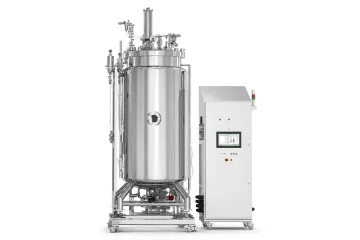
Large-Scale In-Situ Sterilizable Bioreactors & Fermenters
Custom bioreactors.
See system →What a scale transfer is held against
They cannot all be preserved at once: scaling at constant specific power gives a different tip speed. Scale-up is choosing which one governs, and documenting what is allowed to vary.
kLa
The volumetric oxygen transfer coefficient is the criterion most often used for aerobic processes: it is held constant across scales because it governs how much oxygen actually reaches the biomass. It changes with agitation speed and gas flow, so the same value is reached with a different combination of the two at each scale.
Specific power input (P/V)
The power dissipated per unit volume ties mixing to shear. Holding it constant preserves the mixing regime, but as volume grows it forces lower impeller speeds — which is why a process does not transfer by copying rpm.
Impeller tip speed
This is what governs the shear the cells see. For sensitive cultures — mammalian cells, mycelial biomass — it is often the constraint that overrides the others, and it decides impeller geometry before impeller speed.
Specific gas flow (vvm)
Gas volumes per volume of liquid per minute do not carry over linearly: at the larger scale the same vvm means far more gas, with more foam and more CO₂ stripping. Superficial gas velocity is usually scaled instead of vvm.
Geometric similarity
Height-to-diameter ratio, impeller-to-vessel diameter, the number and position of baffles: keeping the proportions across scales is what makes process data comparable. Where full similarity is not possible, you choose which ratio to preserve.
Mixing time
The time the vessel needs to return to homogeneity after an addition grows with volume. At production scale it is what decides whether a base or feed addition creates a local pH or substrate gradient before it distributes.
What stays the same as the scale grows
The same recipes
Bioflex™ carries the same process from bench to industrial scale: recipes, sequences and feed profiles transfer between stages instead of being rewritten.
The same headplate
The benchtop headplate is the same from the glass vessel to the stainless one: probes, ports and the sampling arrangement stay the ones the process was developed on.
The same measured parameters
pH, dissolved oxygen, temperature, pressure and biomass are acquired through the same measurement chain at every scale, so bench and pilot data compare without reconciliation.
Consistent sterilisation
From autoclaving on the bench to in-situ sterilisation on pilot and industrial systems, SIP and CIP cycles are automated and logged: the step up does not change how the process is validated.
Frequently asked questions on scale-up
Moving from shake flask to bioreactor changes how the culture receives oxygen: in the flask exchange happens across the surface, in the bioreactor through bubbles. So you start by fixing the criterion to preserve — for an aerobic process almost always kLa — and derive at each scale the combination of agitation and gas flow that reaches it, checking that impeller tip speed stays below what the cell line tolerates. On the Vinci path this development is done on benchtop systems from 250 mL to 30 L WV and transferred to the later stages with recipes and measurement chain unchanged.
Six criteria are used in practice: kLa, specific power input P/V, impeller tip speed, specific gas flow, geometric similarity and mixing time. They cannot all be preserved at once: scaling at constant P/V, for instance, gives a different tip speed. Scale-up is choosing which criterion governs for that process and documenting what you accept will vary.
The path covers four stages: 250 mL – 30 L WV on the bench with the Biobook series, 20 – 100 L WV for in-situ sterilisable R&D with the BioSIP series, 250 – 800 L WV for pilot and production with the BioFerm series, and above 1,000 L WV with custom bioreactors. The stages share the control platform, so the transfer concerns process parameters rather than rewriting the automation.
Because dissipated power grows with the cube of speed and the fifth power of impeller diameter. Keeping the same rpm at a larger volume therefore means an entirely different specific power and shear. What transfers is the criterion — kLa, P/V or tip speed — and the rpm is recalculated from it at each scale.
Let’s talk about
your scale-up
Tell us the scale you are at today and where you need to get to: our team answers within 24 hours.