Fermented biopolymers
Microbial production of biodegradable polyhydroxyalkanoates in stainless-steel bioreactors — engineered for robust, sterile, scalable fermentation, including the gas-fermentation route that turns CO₂ into plastic.
The challenge
Polyhydroxyalkanoates (PHA) and poly-3-hydroxybutyrate (PHB) are fully biodegradable polyesters that bacteria accumulate intracellularly as carbon/energy stores. Turning that biology into an industrial material is demanding: the organism is grown to high density, then pushed into a polymer-accumulation phase, all under strict sterility and tight control of pH, dissolved oxygen and feed. In the most ambitious route, the carbon source is CO₂ itself — hydrogen-oxidising bacteria such as Cupriavidus necator fix CO₂ (with H₂) into PHA, which adds flammable-gas handling and mass-transfer constraints on top [1][2].
At production scale this is a job for stainless steel, not glass: the process needs steam-in-place sterilisation, pressure rating, robust cleaning and durable, GMP-grade construction that a glass vessel cannot provide.
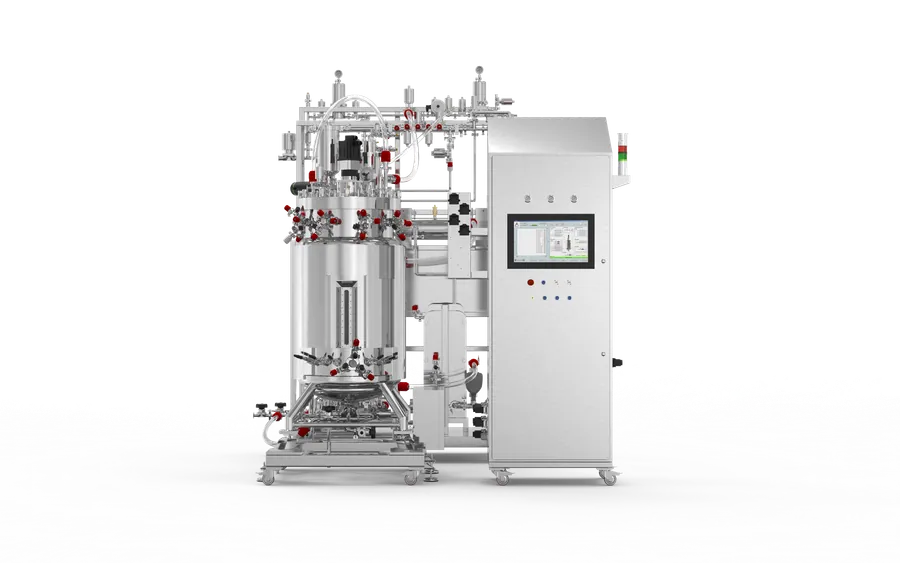
The VINCI technology applied — stainless-steel bioreactor
The reference technology is a 316L stainless-steel stirred-tank (or gas-fermentation) bioreactor, built for the pressure, sterility and scale that industrial biopolymer production requires.
- Why steel, not glass, here. Glass vessels suit lab-scale visibility and small volumes; production PHA needs SIP sterilisation, pressure tolerance, aggressive CIP and industrial durability — all properties of stainless steel.
- High-density fermentation. Efficient oxygen (and, for gas fermentation, H₂/CO₂) transfer to drive the growth phase and then the polymer-accumulation phase.
- Gas-fermentation ready. Configurable for C1/gas substrates (CO₂ + H₂), with the gas handling and controls that route demands.
- SIP/CIP + Bioflex™. Integrated sterilisation and cleaning with automated, auditable recipe control for repeatable batches.
From research to production, one platform
The same parameters and Bioflex™ recipes carry you from bench to industrial scale, reducing transfer risk between stages.
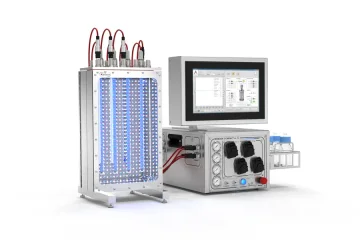
R&D In-Situ Sterilizable Bioreactors & Fermenters
BioSIP series.
See system →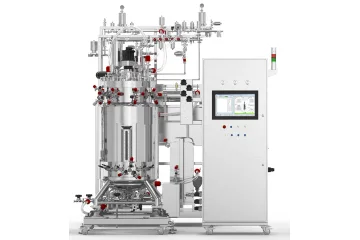
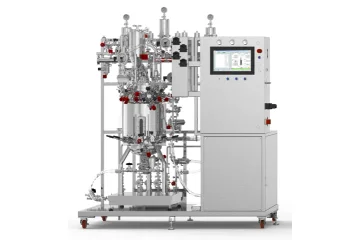
Pilot & Production In-Situ Sterilizable Bioreactors & Fermenters
BioFerm series.
See system →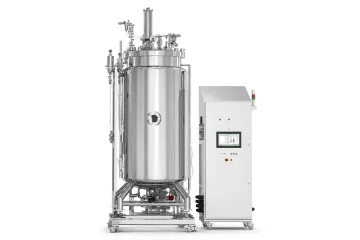
Large-Scale In-Situ Sterilizable Bioreactors & Fermenters
Custom bioreactors.
See system →Performance benchmarks
Figures below are literature/market benchmarks for the PHA-from-CO₂ field — not VINCI or client-owned results.
- CO₂ → biodegradable polymer is proven. Cupriavidus necator has been engineered to produce PHA copolymers (e.g. PHBHHx) directly from CO₂ in controlled jar cultivation [1][2].
- Biodegradable within ~1 year. PHA produced from CO₂ can biodegrade within about a year, unlike conventional plastics [3].
- Large market headroom. PHA demand is projected toward ~1 million tonnes by 2030 against current global output under ~100,000 tonnes — a strong scale-up driver [3].
Scientific sources
- Production of P(3HB-co-3HHx) from CO₂ via pH-stat jar cultivation of an engineered Cupriavidus necator (PMC)
- Efficient production of high-concentration P(3HB-co-3HHx) from CO₂ employing recombinant Cupriavidus necator (PMC)
- Anthropocene Magazine — Chemists use bacteria to convert CO₂ in the air into bioplastic (market figures)
Let’s talk about your process
Tell us about your application: our engineering team replies within 24 hours.

Frequently asked questions
Polyhydroxyalkanoates (PHA) are polyesters that several bacteria accumulate inside the cell as a carbon reserve; PHB (polyhydroxybutyrate) is the best known of them. They are produced by microbial fermentation, feeding the strain a carbon source under conditions that drive polymer accumulation, and the result is a biodegradable, bio-based bioplastic. The gas fermentation route uses CO₂ and H₂ as the substrate instead of a sugar.
Glass suits the bench, where process visibility and small volumes matter. At production scale the process calls for steam-in-place sterilisation, pressure containment, aggressive cleaning and durable industrial-grade construction — conditions that need stainless steel. SIP and CIP cycles are built in and recipe-driven, so sterilisation stays verifiable.